Posts

Showing posts with the label business

Impact of MNCs on the national economy - 4.4.1
Image
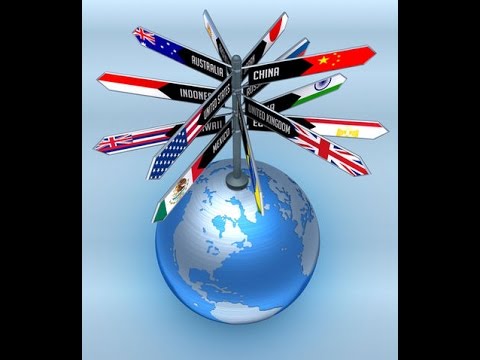
Multinational Corporation (MNC) - is a business that is based or registered in one country but has outlets/affiliates or does business in other countries.  Such companies have offices and/or factories in different countries (typically emerging economies or undeveloped countries due to cost savings) and usually have a centralised head office (typically in western markets e.g. UK and US) where they coordinate global management. Balance of payments - A record of a country's trade/transactions with the rest of the world. A surplus is when the sum of exports of goods/services/investment income/transfers is greater than imports. A deficit is when the sum of exports of goods/services/investment income/transfers is less than imports. Foreign direct investment (FDI) - is an investment in a business by an investor from another country for which the foreign investor has control over the company purchased. Transfer pricing - Two companies that are part of the same MNC use interna...

Niche Markets - Cultural diversity: recognition that groups of people across the globe have different interests and values - 4.3.2

Image
Niche market - A smaller segment of a larger market where customers have specific needs and wants. Cultural diversity - is the range of different people and their values within a society, which may be based on ethnicity, beliefs or other similar factors. Society attempts to take into account all people's values in order to create a just and fair world.  Global niche markers are similar to domestic niche markets in that they target a very specific range of people, though the key is to position a product so that it appeals to a wide range of customers across the global market. CULTURAL DIVERSITY Cultural diversity recognises that the ideas, customs and social behaviour of a particular people or society vary in different global markets. Those businesses that cater for this will thrive but will struggle to identify exactly what niches in the marker that they have to fill. Those who don't are likely to lose market share. Cultural diversity needs to take into account d...

Assessment of a country as a market - 4.2.2

Image
Market attractiveness - A measure of the potential value of a particular market in a country. It can include short-term or long-term profit and growth rate of the market. A range of tools can be used to assess market attractiveness for a country, such as the Boston Matrix, PESTLE and Porter's Five Forces. Disposable income - the total income of an individual has available to spend after paying income taxes and the addition of benefits. Ease of doing business - how accessible markets are for a business Infrastructure - the physical systems that a country (or business) require to operate efficiently Political Stability - an absence of excessive fluctuations in the economy. There are several key issues to consider when assessing the market attractiveness, for example; Levels and growth of disposable income Ease of doing business Infrastructure Political stability Exchange rate LEVELS AND GROWTH OF DISPOSABLE INCOME Changes in disposable income are believed to have...

International Trade and Business Growth - Foreign direct investment (FDI) and link to business growth - 4.1.2

Foreign Direct Investment - is investment made by a business or other entity from one country into the production capacity of a business or other entity from another country e.g. factories Inward FDI / Horizontal FDI - An investment into a country involving an external or foreign company either investing in or purchasing the goods of a local economy. Outward FDI / Vertical FDI - A business strategy in which a domestic firm expands its operations to a foreign country via an investment, merger/acquisition or expansion of an exisiting foreign facility. FDI can be used by businesses to achieve the aim of growth. Countries try to attract FDI using strategies such as lower levels of corporation tax, subsidies for the building of factories, and investment in infrastructure such as roads, ports and airports. It was originally believed that FDI occurred due to differing interest rates in different countries. Businesses would transfer money globally to where they could obtain the highest...

Business Ethics - Corporate Social Responsibility (CSR) 3.4.4

Image
Business ethics - The moral principles that guide the way a business behaves. Corporate Social Responsibility - A business's initiatives regarding the community and environment and willingness to take responsibility for the effects the company's actions have on environmental and social issues and the impact on a range of stakeholders. Pressure groups - A group that tries to influence company policy in the interest of a particular cause. CSR is based on the concept that society needs business to employ staff, make investment and raise taxes from profits and the business needs society to create demand, to use public infrastructure, such as roads and power, and for legal protection. THE SHAREHOLDER CONCEPT Not all business organisations operate in a socially responsible manner. Some argue that it is not the job of businesses to be concerned about social issues and problems. The shareholder concept is closely associated with the writing of US economist Milton Friedman...

Business Ethics - Pay and rewards 3.4.4.

Business ethics - The moral principles that guide the way a business behaves Remuneration - Reward for employment in the form of pay, salary, or wage, including allowances, fringe benefits, bonuses, cash incentives etc. Ethics can be reflected in the way the business recruits, motivates and rewards staff. Is it ethical to pay just the living wage? Should London businesses pay above the living wage? Should senior managers be paid higher remuneration than others in the business? Is it ethical for CEO's to be paid hundreds of more times better than the average employee in the business. The recruitment process needs to be fair and free from bias and should at least follow the law. A company needs to spend money regularly on staff training and development. The trade-off is that these strategies require a significant amount of ongoing financial investment which reduces the business's profits, at least in the short term. Rewards for staff, such as basic pay and bonuses, n...

Business Ethics - Ethics of strategic decision 3.4.4

Image
Business ethics - The moral principles that guide the way a business behaves Trade-off - is when one decision results in the loss of an alternative outcome, for each decision made there may be multiple trade-offs In business ethical standards play a crucial role in the decision-making: Used by individuals to make choices about how to behave They define acceptable conduct in business Should underpin decision making An ethical decision is one that is both legal and meets the shared ethical standards of the relevant business community Note: different countries and cultures have different attitudes to what constitutes acceptable ethical behaviour. Ethics in strategic decisions include: 1) Location decisions Ability to exploit workers Impact on the environment 2) Mergers, takeovers and retrenchment (reducing costs of the business e.g. staffing) Impact on workers Ability to exploit customers or control suppliers Transparency of deals 3) Corruption Dealing with auth...

Corporate Objectives 3.1.1

Image
Business Objectives - is a goal set by a business, usually in the medium to long term. They can be set at any level of the business and can cover financial and non-financial issues important to the business's success Corporate objectives - Measurable, clearly defined targets for how to achieve business aims. Effective objectives should be SMART (specific, measurable, achievable, realistic and time specific) Mission statement - is a short term statement of the company's vision and values which helps to set aims and objectives. This enables employees, managers and customers and possible some suppliers to understand the conduct of the business. It is a statement of purpose, such as 'grow our market share in the UK'. Nike's mission statement is; "To bring inspiration and innovation to every world athlete". Aim - is a generalised statement of what the business plans to achieve in the longer term. A goal or purpose of the business for the future, to inspir...

Stock control and Interpretation of stock control diagram - 2.4.3

Image
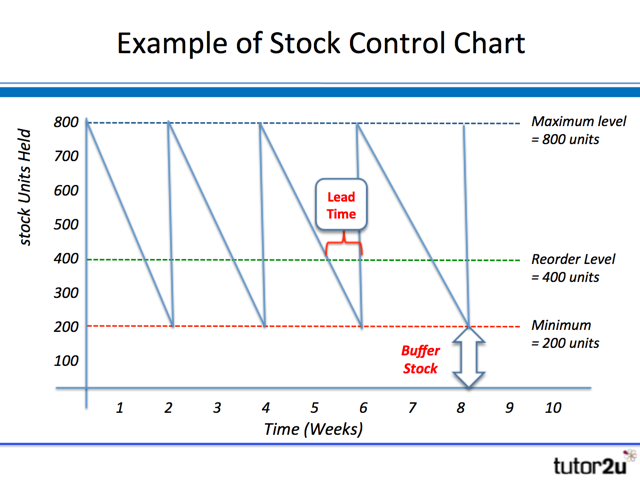
Stock control - stock is a current asset held by business to help meet the demand of customers Stock can be held in 3 forms: Raw materials Work in progress Finished products Stock can be used to fill differences between production output and demand The amount of stock held will depend upon: the business' attitude to risk (Hate risk = large buffer stock) (Love risk = small buffer stock) the importance of speed of response as an operational objective speed of change within the market nature of the product e.g. perishable or long lasting STOCK CONTROL DIAGRAM - A managment tool used to control and monitor the flow of stock LEAD TIME - The time it takes between placing an order and receiving delivery. The GREATER the lead time, the HIGHER the minimum stock level. RE-ORDER LEVEL - The level of stock which triggers and order, this may be done automatically by a computerised system. The re-order level will be determined by both the lead time and the minimum sto...