Posts

Showing posts with the label asset

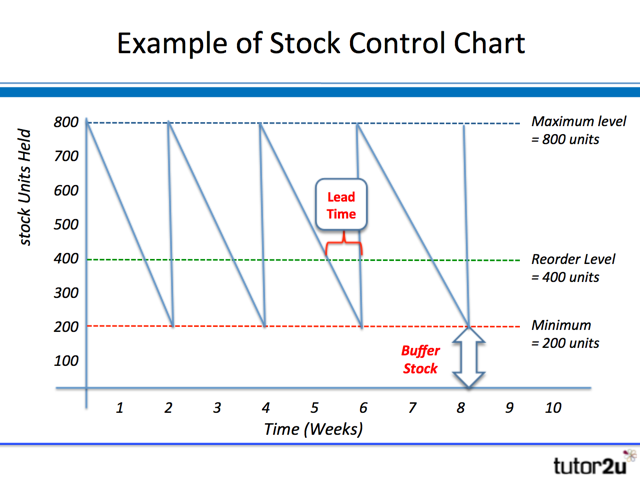
Stock control and Interpretation of stock control diagram - 2.4.3
Image
Stock control - stock is a current asset held by business to help meet the demand of customers Stock can be held in 3 forms: Raw materials Work in progress Finished products Stock can be used to fill differences between production output and demand The amount of stock held will depend upon: the business' attitude to risk (Hate risk = large buffer stock) (Love risk = small buffer stock) the importance of speed of response as an operational objective speed of change within the market nature of the product e.g. perishable or long lasting STOCK CONTROL DIAGRAM - A managment tool used to control and monitor the flow of stock LEAD TIME - The time it takes between placing an order and receiving delivery. The GREATER the lead time, the HIGHER the minimum stock level. RE-ORDER LEVEL - The level of stock which triggers and order, this may be done automatically by a computerised system. The re-order level will be determined by both the lead time and the minimum sto...

METHODS OF FINANCE - Leasing (SHORT AND LONG TERM)

Leasing -  Allows a business to benefit from the use of an asset without owning it or buying it outright. This is a flexible form of finance, a regular monthly payment secures the use of an asset. The business pays a set amount in installments to lease the asset without owning it or buying it outright. The asset remains the property of the leasing company and at the end of the time period the asset is returned to the lease company and the business stops making payments. Avoids the need to finance the asset but may be more costly in the long run. However, the lease company is responsible for any repairs and maintenance. At the end of the lease period the business may start a new lease agreement for the latest model. Leasing reduces the need for finance at the outset but if the cash flow is unreliable the regular payments can be a problem.

Staff as an ASSET or a COST 1.4.1

In terms of approaches to how management view human resources, a popular distinction is made between treating staff as an asset ("soft" HRM) and treating them as a cost ("hard" HRM). Staff as an Asset (SOFT HRM) ▪ Treats employees as the most important resource in the business and a source of competitive advantage. ▪ Employees are treated as individuals and then needs our plan accordingly. FOCUS = Concentrate on the needs of the employees - their roles, rewards, motivation etc Staff as a Cost (HARD HRM) ▪Treats employees simply as a resource of the business. ▪ Strong links with corporate business planning - what resources do we need, how do we get them and how much will they costs FOCUS = Identify workforce needs of the business and recruit and manage accordingly ( hiring, moving and firing) KEY FEATURES TO SOFT AND HARD HRM SOFT HRM Strategic focus on longer-term workforce planning Strong and regular two way communication Competi...