Posts

Showing posts with the label customers

Niche markets - Features of global niche markets 4.3.2

Niche market - A smaller segment of a larger market where customers have specific needs and wants. Global market niches are subcultures in world society. These share common interests and can be identified as market segments on a global scale. Although a niche tagets a smaller market, on a global scale, this can be sizeable. This is particularly profitable when we recognise that these are likely to highly differentiated products rather than low costs. This means that the world's wealthiest consumers can be targeted, with the quality of the product being the most important factor. Other common features of a global niche market include; Requires high levels of customer service as demanding customers pay for quality not quantity Highly skilled employees with the expertise and, at times, the reputation required to create and sell the desired products Product innovation is essential in order to product the highly differentiated products that customers require A high level...

Niche Markets - Cultural diversity: recognition that groups of people across the globe have different interests and values - 4.3.2

Image
Niche market - A smaller segment of a larger market where customers have specific needs and wants. Cultural diversity - is the range of different people and their values within a society, which may be based on ethnicity, beliefs or other similar factors. Society attempts to take into account all people's values in order to create a just and fair world.  Global niche markers are similar to domestic niche markets in that they target a very specific range of people, though the key is to position a product so that it appeals to a wide range of customers across the global market. CULTURAL DIVERSITY Cultural diversity recognises that the ideas, customs and social behaviour of a particular people or society vary in different global markets. Those businesses that cater for this will thrive but will struggle to identify exactly what niches in the marker that they have to fill. Those who don't are likely to lose market share. Cultural diversity needs to take into account d...

Impact of external influences - Porter's Five Forces 3.1.4

Image
Porter's Five Force analysis - A tool to analyse five competitive forces that affect a market and the intensity of competition within a industry or market. Barriers to entry - The obstacles that a business has to face when it is considering competing in an exisiting market It considers the threat of new entrants to a market the bargaining power of suppliers the bargaining power of customers the threat of substitute products the degree of competitive rivalry amongst exisiting competitors. It attempts to provide a simple way to look at all the relevant issues related to the changing competitive environment in which a business operates. Five Forces can be used by a business currently in a market to assess the security of its market position. Or it can be used by a business thinking of entering a market. THREAT OF NEW ENTRANTS Refers to the potential effect of a new business entering the market, presuming that it will gain market share and rivalry will increase. T...

Growth: Increased market power over customers and suppliers - 3.2.1

Growth - A common corporate objective which means expanding the sales revenue of a business, probably in the hope that profits will increase too. A business will aim to achieve greater market power, which gives it more control over its future, including a greater ability to increase prices. Greater dominance over customers means pricing control ; greater dominance over suppliers gives increasing power to keep purchasing costs down. This allows the business to gain a competitive advantage.

Internal and External stakeholders and Stakeholder Objectives - 3.4.3

Stakeholder - is any individual or group with an interest in the actions and decision making of the business. A SHAREHOLDER IS A STAKEHOLDER INTERNAL STAKEHOLDER EXTERNAL STAKEHOLDER Employees Customers Managers Suppliers Owners Shareholders Shareholders Government Local community Society Creditors (owes money to a business) STAKEHOLDER MAIN INTERESTS Shareholders/owners Return on investment and profits and dividends Success and growth of the business Proper running of the business Managers/employees Rewards, including basic pay and other financial incentives Job security and working conditions Promotion opportunities and job satisfaction and status – motivation, roles and responsibilities Customers Value for money Product quality and customer service Suppliers Continued, profitable trade with th...

Corporate Culture - Strong and weak cultures - 3.4.2

A strong culture - is one which is deeply embedded into the ways a business or organisation does things. With a strong culture, employees and management understand what is required of them and they will try to act in accordance with the core values. A weak culture - can arise when the core values are not clearly defined, communicated or widely accepted by those working for the organisation.  It can also occur if there is little alignment between the way things are done and the espoused values. This can lead to inconsistent behaviour of people in the organisation which in turn results in inconsistent customer experiences! Strong Culture Weak Culture Staff respond positively to culture values Little alignment with culture values Shared sense of responsibility towards vision, mission and objectives Employees have to be forced to perform duties Motivated and loyal workforce Greater management control...

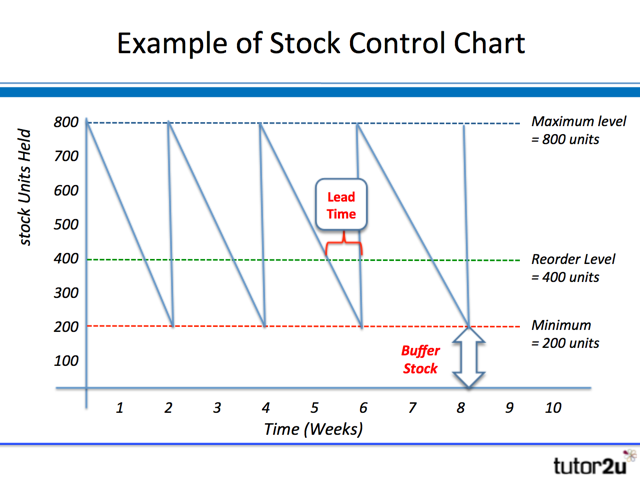
Stock control and Interpretation of stock control diagram - 2.4.3

Image
Stock control - stock is a current asset held by business to help meet the demand of customers Stock can be held in 3 forms: Raw materials Work in progress Finished products Stock can be used to fill differences between production output and demand The amount of stock held will depend upon: the business' attitude to risk (Hate risk = large buffer stock) (Love risk = small buffer stock) the importance of speed of response as an operational objective speed of change within the market nature of the product e.g. perishable or long lasting STOCK CONTROL DIAGRAM - A managment tool used to control and monitor the flow of stock LEAD TIME - The time it takes between placing an order and receiving delivery. The GREATER the lead time, the HIGHER the minimum stock level. RE-ORDER LEVEL - The level of stock which triggers and order, this may be done automatically by a computerised system. The re-order level will be determined by both the lead time and the minimum sto...

Working Capital and it's management 2.3.2

Image
Working capital - provides a strong indication of a business' ability to pay is debts. By adding together the totals for current assets and current liabilities in the balance sheet, a very important figure can be calculated – working capital. Working capital = current assets - current liabilities   Every business needs to be able to maintain day-to-day cash flow. It needs enough to pay staff wages when they are due, and to pay suppliers when invoice payment terms are reached. Maintaining adequate working capital is important both in the short-term (day-to-day) and the long-term. The challenge is to maintain sufficient liquidity in the business to ensure the business can survive and grow in the long-term. The current liabilities show the amounts that need to be paid in the next twelve months. Current assets show the cash and other assets that are available to settle those current liabilities. Of course the balance sheet is just a snapshot...

Methods of Improving Profits and Profitability 2.3.1

Increasing profitability is often a major aim for growing businesses. There are several ways in which this can be achieved. Businesses are not limited to one of these options but must realise each option has knock on implications. 1) SELL THE SAME AMOUNT AT HIGHER PRICE This will hopefully increase your revenue... HOWEVER , Will you lose customers if prices are raised? What prices do competitors charge? because if you're too high then customers could just go to your competitors as some believe more in a bargain than brand loyalty, so how loyal are your customers? Will you have to spend more on maintaining brand image? Higher prices drives customers away, leaving a bad reputation on the brand so the business may have to maintain its brand image to keep a customer base. This option is only good if the product is price inelastic such as gasoline because the business has a necessity good that consumers don't mind if prices go up a little bit, meaning demand doesn't fall rap...